
Thursday, May 24, 2012
Hundreds of Stock Photos Add Up to One Very Sweet Love Story [Video]
Hundreds of Stock Photos Add Up to One Very Sweet Love Story [Video]:
To create an ad for Getty Images, agency AlmapBBDO sorted through some 5,000 stock photo images and found 873 of them that they pieced together to paint a picture of an entire life in one minute. From Love to Bingo is really quite remarkable, and it definitely shows the range of stock imagery—though now we need an alternate version to explain how all of those totally bizarre shots of couples sleeping in bed with a christmas tree and dogs dressed as professors fit into the course of a normal life. More »


Love Is Wise, Hatred Is Foolish: Bertrand Russell on Rationality and Tolerance, 1959
Love Is Wise, Hatred Is Foolish: Bertrand Russell on Rationality and Tolerance, 1959:
What the cult of fact has to do with the essential condition for the survival of the human race.
One need only look to British philosopher, mathematician, and sociocultural critic Bertrand Russell’s 10 commandments of teaching to understand his profound grasp on culture and the human condition. In this equally inspiring and timeless excerpt from BBC’s 1959 Face to Face interview, Russell articulates in just under two minutes one of the most important and admirable aspirations we could hope to live up to, both individually and as a society — a beautiful complement to Einstein’s wisdom on kindness and our shared humanity.
Thanks, Neil
 Brain Pickings has a free weekly newsletter and people say it’s cool. It comes out on Sundays and offers the week’s best articles. Here’s what to expect. Like? Sign up.

Brain Pickings takes 450+ hours a month to curate and edit across the different platforms, and remains banner-free. If it brings you any joy and inspiration, please consider a modest donation – it lets me know I'm doing something right.


What the cult of fact has to do with the essential condition for the survival of the human race.
One need only look to British philosopher, mathematician, and sociocultural critic Bertrand Russell’s 10 commandments of teaching to understand his profound grasp on culture and the human condition. In this equally inspiring and timeless excerpt from BBC’s 1959 Face to Face interview, Russell articulates in just under two minutes one of the most important and admirable aspirations we could hope to live up to, both individually and as a society — a beautiful complement to Einstein’s wisdom on kindness and our shared humanity.
I should like to say two things, one intellectual and one moral.Catch the full BBC interview, very much worth the watch in its entirety, here:
The intellectual thing I should want to say is this: When you are studying any matter, or considering any philosophy, ask yourself only what are the facts and what is the truth that the facts bear out. Never let yourself be diverted either by what you wish to believe, or by what you think would have beneficent social effects if it were believed. But look only, and solely, at what are the facts. That is the intellectual thing that I should wish to say.
The moral thing I should wish to say to them is very simple: I should say, love is wise, hatred is foolish. In this world which is getting more and more closely interconnected, we have to learn to tolerate each other, we have to learn to put up with the fact that some people say things that we don’t like. We can only live together in that way — and if we are to live together and not die together, we must learn a kind of charity and a kind of tolerance, which is absolutely vital to the continuation of human life on this planet.
Thanks, Neil
Brain Pickings has a free weekly newsletter and people say it’s cool. It comes out on Sundays and offers the week’s best articles. Here’s what to expect. Like? Sign up.Wednesday, May 23, 2012
Tuesday, May 22, 2012

Blown Covers: New Yorker Covers You Were Never Meant to See
Blown Covers: New Yorker Covers You Were Never Meant to See:
The art-science of walking the fine line between keen and crass.
 Since its inception in 1925, The New Yorker has garnered remarkable reverence as much for its editorial style as it has for its inimitable covers, a singular medium for political and sociocultural visual satire matched perhaps only by Al Jaffee’s legendary MAD magazine fold-ins. In Blown Covers: New Yorker Covers You Were Never Meant to See, Françoise Mouly, New Yorker art director of nearly two decades, offers exactly what it says on the tin — a delicious forbidden taste of the art that didn’t quite nail it, or nailed it a bit too hard.
From Monica Lewinsky with a lollipop to Osama Bin Laden appraising proposed designs for the new World Trade Center, the images come from a slew of beloved New Yorker regulars, including Brain Pickings favorites Christoph Niemann, R. Crumb, and Art Spiegelman (who happens to be Mouly’s partner), and explore — some might say, exploit — our most deep-seated cultural conceits, our grandest fears, our most irrational beliefs, and our greatest unspoken truths. What emerges is a fascinating and unprecedented glimpse of the creative process behind the art of walking the fine line between the humorous and the haughty, the keen and the crass, the unapologetic and the too unapologetic.

Before arriving at the right character set to poke fun at our fears of terrorism -- two Arab men -- Barry Blitt tried the idea with two children and two businessmen. Ultimately, the idea was scrapped -- the reference to the mild DIY explosive, despite the viral fame of the Mentos + Diet Coke mixing experiments, was deemed too obscure for the magazine's audience.
Art Spiegelman winked at Norman Rockwell's 'Freedom from Want' to comment on anti-Muslim violence.
Immediately preceding the U.S. invasion of Iraq in 2003, Christoph Niemann captured the anti-French sentiments sweeping America.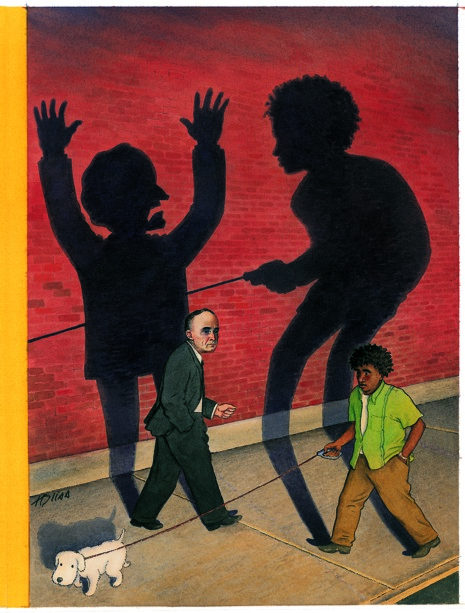
After Haitian immigrant Abner Louima was assaulted by white NYPD officers in 1997, Harry Bliss zeroed in on then-Mayor Rudy Giuliani's semi-secret paranoia.
Though Art Spiegelman didn't make the cover cut with this 1993 sketch, he and Mouly made it into the family's Christmas card that year.Much of what makes the book special — and, no doubt, what makes New Yorker covers sing — is Mouly’s relationship with the artists, whom she consistently encourages not to self-sensor or hold anything back. There emerges a kind of “fail better” mentality, underpinned by her conviction that even the most outrageous idea may serve as a gateway to an inspired, publishable line of thinking.
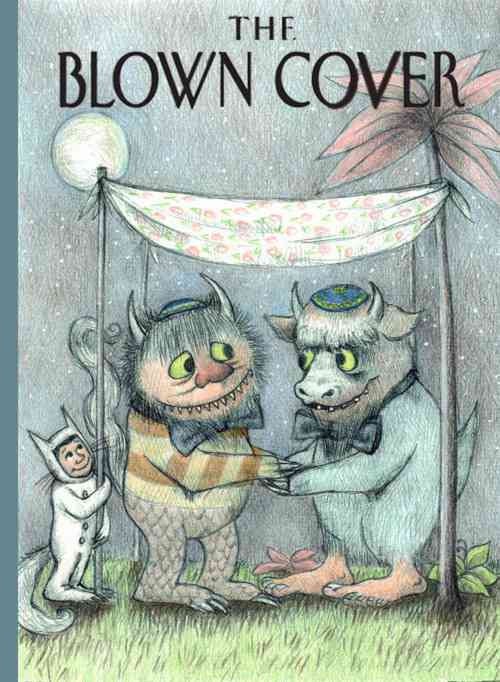
The book’s companion site offers a weekly cover contest, the entries to which have been surprisingly excellent. My favorite, by writer and illustrator Ella German, came last week, themed “The Gays,” in light of the recent historic moment for marriage equality, but also referencing Maurice Sendak, who had passed away the previous week. Though far from a gay rights activist, Sendak lived as an openly gay man with his partner of half a century. The two never had the opportunity to marry.
What Here At The New Yorker did for the magazine’s editorial voice on its 50th anniversary in 1975, Blown Covers has done for its brand of visual satire, offering a rare glimpse of Oz behind the curtain. And to those whose first blush might be that Oz is better off unseen and omnipotent, Mouly offers the following lens in this interview on Imprint:
Brain Pickings has a free weekly newsletter and people say it’s cool. It comes out on Sundays and offers the week’s best articles. Here’s what to expect. Like? Sign up.

Brain Pickings takes 450+ hours a month to curate and edit across the different platforms, and remains banner-free. If it brings you any joy and inspiration, please consider a modest donation – it lets me know I'm doing something right.

The art-science of walking the fine line between keen and crass.
Since its inception in 1925, The New Yorker has garnered remarkable reverence as much for its editorial style as it has for its inimitable covers, a singular medium for political and sociocultural visual satire matched perhaps only by Al Jaffee’s legendary MAD magazine fold-ins. In Blown Covers: New Yorker Covers You Were Never Meant to See, Françoise Mouly, New Yorker art director of nearly two decades, offers exactly what it says on the tin — a delicious forbidden taste of the art that didn’t quite nail it, or nailed it a bit too hard.From Monica Lewinsky with a lollipop to Osama Bin Laden appraising proposed designs for the new World Trade Center, the images come from a slew of beloved New Yorker regulars, including Brain Pickings favorites Christoph Niemann, R. Crumb, and Art Spiegelman (who happens to be Mouly’s partner), and explore — some might say, exploit — our most deep-seated cultural conceits, our grandest fears, our most irrational beliefs, and our greatest unspoken truths. What emerges is a fascinating and unprecedented glimpse of the creative process behind the art of walking the fine line between the humorous and the haughty, the keen and the crass, the unapologetic and the too unapologetic.
Before arriving at the right character set to poke fun at our fears of terrorism -- two Arab men -- Barry Blitt tried the idea with two children and two businessmen. Ultimately, the idea was scrapped -- the reference to the mild DIY explosive, despite the viral fame of the Mentos + Diet Coke mixing experiments, was deemed too obscure for the magazine's audience.
Art Spiegelman winked at Norman Rockwell's 'Freedom from Want' to comment on anti-Muslim violence.
Immediately preceding the U.S. invasion of Iraq in 2003, Christoph Niemann captured the anti-French sentiments sweeping America.
After Haitian immigrant Abner Louima was assaulted by white NYPD officers in 1997, Harry Bliss zeroed in on then-Mayor Rudy Giuliani's semi-secret paranoia.
Though Art Spiegelman didn't make the cover cut with this 1993 sketch, he and Mouly made it into the family's Christmas card that year.
The book’s companion site offers a weekly cover contest, the entries to which have been surprisingly excellent. My favorite, by writer and illustrator Ella German, came last week, themed “The Gays,” in light of the recent historic moment for marriage equality, but also referencing Maurice Sendak, who had passed away the previous week. Though far from a gay rights activist, Sendak lived as an openly gay man with his partner of half a century. The two never had the opportunity to marry.
What Here At The New Yorker did for the magazine’s editorial voice on its 50th anniversary in 1975, Blown Covers has done for its brand of visual satire, offering a rare glimpse of Oz behind the curtain. And to those whose first blush might be that Oz is better off unseen and omnipotent, Mouly offers the following lens in this interview on Imprint:
One could have to do with demystifying, making the process more predictable. But I actually think that it’s so rich and so interesting that it’s actually even more interesting if you have a sense of how the images are thought about, rather than less. It doesn’t explain anything because it still is genius when somebody gets the right idea.Images courtesy of Abrams Books
Brain Pickings has a free weekly newsletter and people say it’s cool. It comes out on Sundays and offers the week’s best articles. Here’s what to expect. Like? Sign up.Monday, May 21, 2012

Sunday, May 20, 2012

Saturday, May 19, 2012
Thursday, May 17, 2012

How to Balloon Map Your Neighborhood, Google Maps Style [Video]
How to Balloon Map Your Neighborhood, Google Maps Style [Video]:

Ever felt like Google Maps doesn't provide enough detail of the aerial view of your neighborhood? Ever wanted to make your own maps or participate in a little homegrown science? Balloon mapping is a cheap way to take aerial pictures for all sorts of purposes—even events like weddings, graduations, or parties—and it's dead simple to do it yourself. Here's how it works. More »


Wednesday, May 16, 2012
Recipes and Household Tips from Great Writers
Recipes and Household Tips from Great Writers:
Tiramisu à la Proust, hanging wallpaper with Hemingway, weeding by hand with Émile Zola, and other domestic adventures with literary greats.
 Household chores. We dread them, we put them off indefinitely, we think of them as anything but entertainment. But here comes The Household Tips of the Great Writers — an imaginative and impossibly humorous omnibus of literary impersonation by parodist extraordinaire Mark Crick, who guides us through the art and craft of cooking, gardening, and fixing up the house with the help of some of modern history’s most celebrated literary icons. The real joy of the book, of course, aren’t so much the specific recipes and tips — though who could resist a quick miso soup à la Kafka? — as the comedic precision with which Crick caricatures, lovingly, each writer’s voice.
From boarding the attic with Edgar Allan Poe (“Working from the corner furthest from the feeble light source, which scarce illuminated my labours, I began to lay the boards. Those dark recesses, unlooked upon since the cloak of slate first enveloped them in eternal night, resisted my intrusion like the densest thicket.”) to putting up a garden fence with Hunter S. Thompson (“He lifted a size-eleven foot onto the spade, his leg peeking coquettishly through the slit trouser leg, and the blade sank into the ground. There was a lot to do.”) to burying bulbs in autumn with Sylvia Plath (“I swallowed trying again to clear the bitter taste from my mouth then I tipped the bulbs from the bag and watched as their fat little bodies rolled around on the garden path.”), Crick has all your household and gardening needs and emergencies covered.

Then there’s the kitchen, with its delectable tapas bar of literary treats. Start with tarragon eggs à la Jane Austen:
Illustration: “Snacks of Great Scribblers” by Wendy MacNaughton
Brain Pickings has a free weekly newsletter and people say it’s cool. It comes out on Sundays and offers the week’s best articles. Here’s what to expect. Like? Sign up.

Brain Pickings takes 450+ hours a month to curate and edit across the different platforms, and remains banner-free. If it brings you any joy and inspiration, please consider a modest donation – it lets me know I'm doing something right.

Tiramisu à la Proust, hanging wallpaper with Hemingway, weeding by hand with Émile Zola, and other domestic adventures with literary greats.
Household chores. We dread them, we put them off indefinitely, we think of them as anything but entertainment. But here comes The Household Tips of the Great Writers — an imaginative and impossibly humorous omnibus of literary impersonation by parodist extraordinaire Mark Crick, who guides us through the art and craft of cooking, gardening, and fixing up the house with the help of some of modern history’s most celebrated literary icons. The real joy of the book, of course, aren’t so much the specific recipes and tips — though who could resist a quick miso soup à la Kafka? — as the comedic precision with which Crick caricatures, lovingly, each writer’s voice.From boarding the attic with Edgar Allan Poe (“Working from the corner furthest from the feeble light source, which scarce illuminated my labours, I began to lay the boards. Those dark recesses, unlooked upon since the cloak of slate first enveloped them in eternal night, resisted my intrusion like the densest thicket.”) to putting up a garden fence with Hunter S. Thompson (“He lifted a size-eleven foot onto the spade, his leg peeking coquettishly through the slit trouser leg, and the blade sank into the ground. There was a lot to do.”) to burying bulbs in autumn with Sylvia Plath (“I swallowed trying again to clear the bitter taste from my mouth then I tipped the bulbs from the bag and watched as their fat little bodies rolled around on the garden path.”), Crick has all your household and gardening needs and emergencies covered.
Then there’s the kitchen, with its delectable tapas bar of literary treats. Start with tarragon eggs à la Jane Austen:
40g butterFollow with mushroom risotto à la John Steinbeck:
4 eggs
Ground pepper
Pinch of salt
2 teaspoons tarragon (fresh or dried)
[…]
The possibility that her eggs might find themselves cooked with the aristocratic herb sent Mrs. B— into such a state of excitement that Lady Cumberland would have risen to leave were it not for the promise of luncheon. Instead she instructed her host to produce the dish without delay: ‘I suggest you begin.’
[…]
Extra virgin olive oilFinish with tiramisu à la Marcel Proust:
25g porcini mushrooms
3 field mushrooms
1 onion
2 cloves garlic
200g risotto rice
500ml vegetable stock
Salt and pepper
60g Parmesan
1 glass white wine
The porcini lay dry and wrinkled, each slice twisted by thirst and the colour of parched earth. When the water finally fell, at first only in splashes, they drank what they could, but soon they were all covered with the life-giving liquid. The parched fragments recovered an earlier form, their contortions changed, by the gift of the water, into a supine mass, glistening What had resembled a bowl of tree bark now had the rich colour of cooked meat, the purple brown of wet soil had replaced the dry plaster of Arizona earth.
[…]
12-15 Saviardi sponge fingersWhether you consider yourself a bibliophile, a culinary connoisseur, or a modern-day MacGyver, The Household Tips of the Great Writers is bound to tickle your fancy and impart a handy tip or two along the way — because who doesn’t want to know how to prune a rose like Pablo Neruda?
4 eggs
100g caster sugar
Amaretto di Saronno
500g mascarpone
2 cups cold coffee
Cocoa powder
[…]
From this ancient past — its great houses gone and its inhabitants dwindling, like the last creatures of a mythical forest — came something infinitely more frail and yet more alive, insubstantial yet persistent; the memories of smell and taste, so faithful, resisted the destruction and rebuilt for a moment the palace wherein dwelt the remembrance of that evening and that tiramisu.
Illustration: “Snacks of Great Scribblers” by Wendy MacNaughton
Brain Pickings has a free weekly newsletter and people say it’s cool. It comes out on Sundays and offers the week’s best articles. Here’s what to expect. Like? Sign up.Monday, May 14, 2012

Sunday, May 13, 2012


Researcher Runs IP Network Over Xylophones
Researcher Runs IP Network Over Xylophones:
joabj writes "Following up on experiments of running Internet Protocol(IP)-based networks with carrier pigeons or bongos, UofC grad student R. Stuart Geiger has demonstrated that it is possible to transmit simple ping requests across two computers using people playing xylophones. Throughput is roughly 1 baud, when the participants don't make any mistakes, or get bored and wander off. The OSI encapsulated model of networking makes this project doable, allowing humans to be inserted at Layer 1, the physical layer. Vint Cerf wasn't kidding when he used to say, 'IP on Everything.'"


Read more of this story at Slashdot.

joabj writes "Following up on experiments of running Internet Protocol(IP)-based networks with carrier pigeons or bongos, UofC grad student R. Stuart Geiger has demonstrated that it is possible to transmit simple ping requests across two computers using people playing xylophones. Throughput is roughly 1 baud, when the participants don't make any mistakes, or get bored and wander off. The OSI encapsulated model of networking makes this project doable, allowing humans to be inserted at Layer 1, the physical layer. Vint Cerf wasn't kidding when he used to say, 'IP on Everything.'"
Saturday, May 12, 2012
Friday, May 11, 2012
Thursday, May 10, 2012
Wednesday, May 09, 2012
Tuesday, May 08, 2012
Monday, May 07, 2012
Subscribe to:
Posts (Atom)